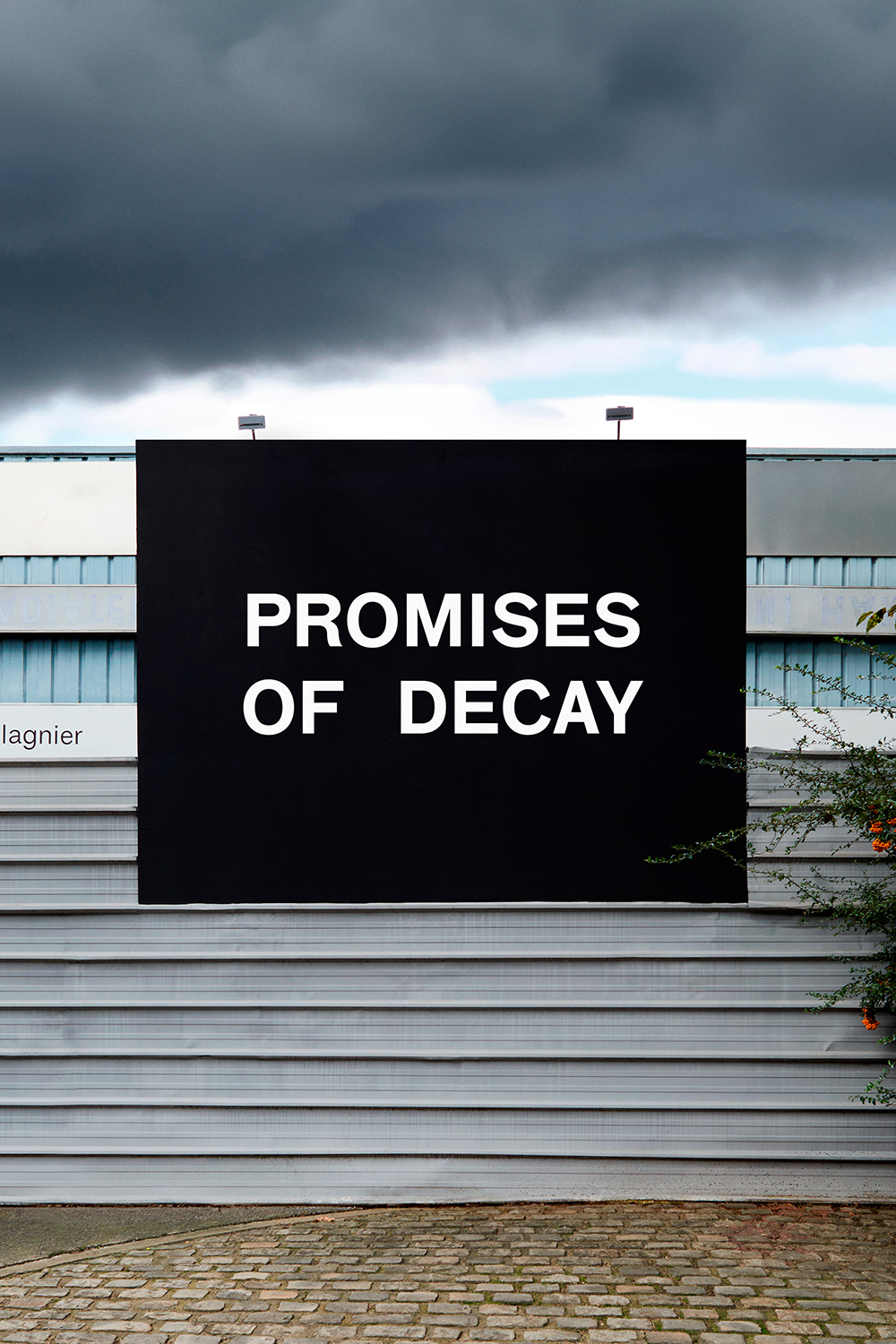
All is not lost, it seems; in fact, nothing is ever truly lost, and it is on the slopes of decay that such a statement comes into sharp focus. It takes a rather dark twilight, if not a truly opaque night, to perceive the flickering yet kind light of a will-o’-the-wisp. It takes a space, a time, for wandering souls to meet again, so that in the end, their needs are met. There is indeed poetry in sifting through the debris of a worn-out world, speaking of the day after tomorrow, building temples of dust, and betting on the survival of the weakest…
By conceding to time the shape of a whirlpool or a Möbius strip, rather than that of a stretched and infinite line, we also grant it some power to always bring back to the forefront what, at first glance, fades and disperses. While some fear erasure, disappearance, and decay perceived as inevitable preludes to the end, others assign them a prophetic power and a poetic depth. The latter can be recognized by their trading of pessimism and passive nostalgia for much more ambiguous states, whose vocabulary is often untranslatable: thus goes saudade, the prospective melancholy of the Portuguese; Sehnsucht, the nostalgia for the unknown of the Germans; or blues, the confrontation of joy and sadness organized by the songs of slaves. They speak not of «rebirth» (as one might say of an urban area), «new era,» or «post-world,» but of utopia, courage, and healing. “Above the shattered world”, they are seen “stretch[ing] a pure blue heaven, which continues to hold it together”, to borrow the words of Elias Canetti. They are also said to possess both wisdom and cunning for this purpose, a skill the Ancients called metis : a blend, an ambiguity that can shake the most resigned certainties, surpass untenable situations, and opens up a space for an interregnum.
From all this arise makeshift monuments that Dahlia Koum Sam raises to misfortunate peoples, who tread on lands sullied by pain and trauma; proud figures that Jean-Christian Bourcart encounters in Camden in 2008 – a city labelled as the most dangerous in the United States – who, refuting a fall they have put on hold, strive to float; humanity being recomposed, perhaps under the impulse of a new religion, depicted by Rémy Schlechta; fragmentary waste that Loucia Carlier reassembles, giving the underbelly of the city an auspicious taste ; love that survives death and the sublime of the malformed arranged by the moutaincutters duo.
In resistance to the logic of ultimate ends and apocalypse, disassembled and reassembled, a whole romantic arc is drawn, to which no region or epoch has exclusive privilege, as long as one is willing to admit that the current known as «romanticism» is merely a culturally situated expression. A romantic arc, indeed, that imposes itself as an attitude toward the world and a way of digesting it – a deep emotional undercurrent, an attitude that pierces through boundaries and centuries, and that never admits to being disarmed in the face of stages of decline, sure that nothing is ever truly lost.
Guillaume Blanc-Marianne
-LA SIRA : PROMISES OF DECAY (Ten Days in Paris, 2024)